COMPACT HANDOFF
8 port ethernet switch fast
An 8 port ethernet switch fast handoff is a short sheet, not a catalog. Fast Ethernet here means 100 Mb/s on the copper ports, the 100BASE-TX rate, unless you explicitly widen a port to 1000 Mb/s. LinkScope Sourcing 15 uses the sheet to mark which rows are decided and which rows the factory must still answer.
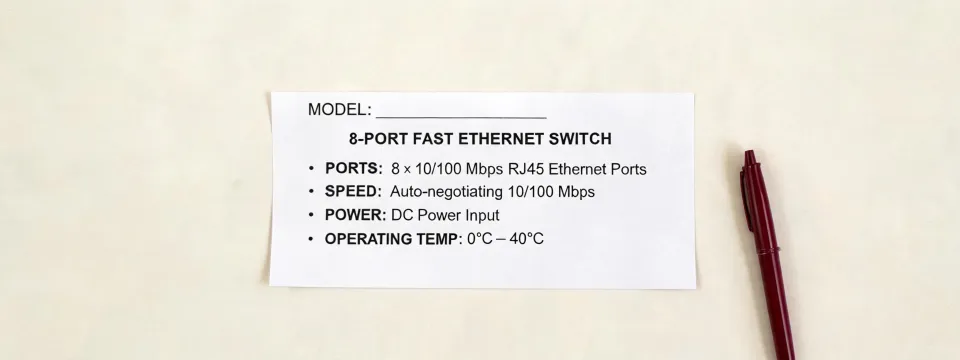
| Row | Buyer status | What the factory returns |
|---|---|---|
| Eight copper ports at 100 Mb/s | Usually the reason this keyword was chosen | Confirm 100BASE-TX, and say if any port is 10/100/1000 instead |
| Uplink | Open until you circle one | Shared copper, or an SFP cage with wavelength and reach |
| PoE | Open | None, 802.3af, or 802.3at, plus the total watt budget of this 8-port model |
| Management | Open | Unmanaged, smart, or a full CLI, and any license that changes the price |
| Mounting | Open | Desktop, wall, or rack ears, with depth in millimeters |
Rows that stay blank until a model is named
- Forwarding rate. Ask for Mpps and the frame size. An 8-port Fast Ethernet fabric is small next to a 32-port gigabit unit. The number still has to come from the datasheet, because a full-mesh assumption at 100 Mb/s is arithmetic, not a test.
- Switching capacity. Request the Gb/s figure printed for the model. Do not scale it from the port count.
- Power input. External brick versus internal supply changes the spare-parts line and the heat in a small cabinet.
- Condition. New and refurbished 8-port units can both answer a legacy Fast Ethernet segment. Warranty months and firmware entitlement differ. Keep them in two columns.
- Applicable filings. FCC equipment authorization and any NRTL mark are requested for the exact model headed to a US address. The sheet does not stamp those filings.
Choices still open on a short sheet
Stay at 100 Mb/s or step a port to gigabit?
Fast Ethernet remains a coherent request when every attached device is a 100 Mb/s endpoint and the uplink is modest. It becomes the wrong row when an access point or a recorder expects 1000 Mb/s. Write the endpoint speeds. If one port must be gigabit, say which one, so the supplier does not swap the whole unit for a different family without marking the change.
Unmanaged simplicity or a managed VLAN?
An unmanaged 8-port unit avoids a configuration file. A managed unit is the row when the segment must be separated from other traffic. The overhead is real: a firmware branch, a password, and sometimes a license. State the overhead you accept. Do not describe either choice as a universal upgrade.
What to verify before accepting an alternative faceplate?
Match copper speed, PoE class if any, uplink form, mounting, and the operating temperature. Then read forwarding rate and power-supply type. A photograph of eight ports is not that match. Optics, if an SFP alternative appears, need wavelength and fiber mode checked against the existing plant. Single-mode and multimode stay incompatible even when both cages look alike.
The wider family is indexed on the port cards. A finished sheet is sent from the brief form. On the Fast Ethernet sheet, still request switching capacity in Gb/s and forwarding rate in Mpps for 64-byte frames, even though eight 100BASE-TX ports are a small fabric next to 1000BASE-T. Power over Ethernet, when marked present, is 802.3af at 15.4 W or 802.3at at 30 W plus the 8-port chassis total. An SFP alternative needs wavelength, transmit power in dBm, receiver sensitivity in dBm, optical budget, and insertion loss. Return loss stays with the connector. Height is either a fraction of a rack unit or a desktop shell measured in millimeters.
Send the compact sheet
Copy the decided rows and leave the open rows as questions. Quantity, US destination, and timing sit in the same field. No upload control is attached to this page.